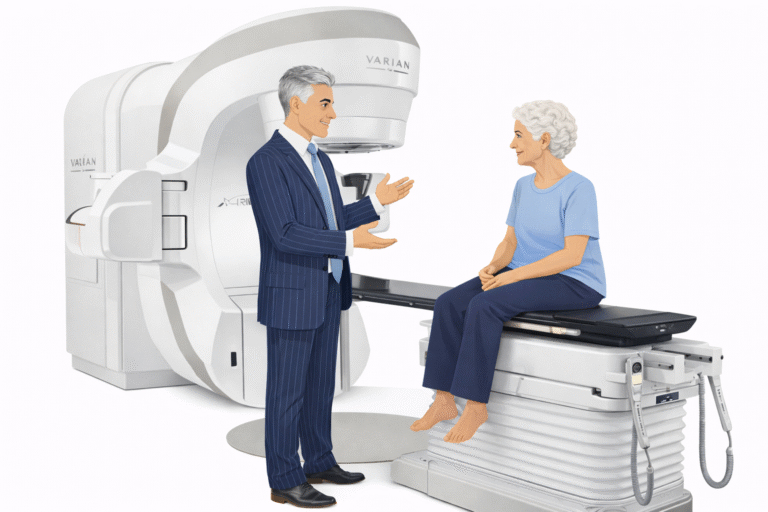
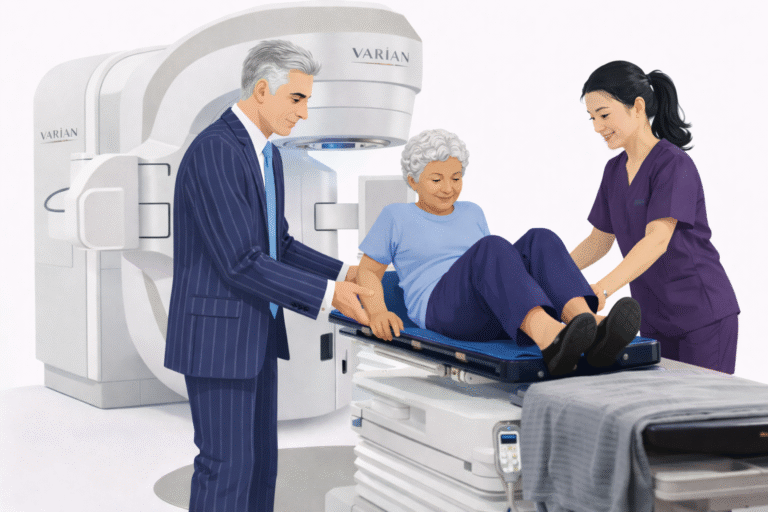
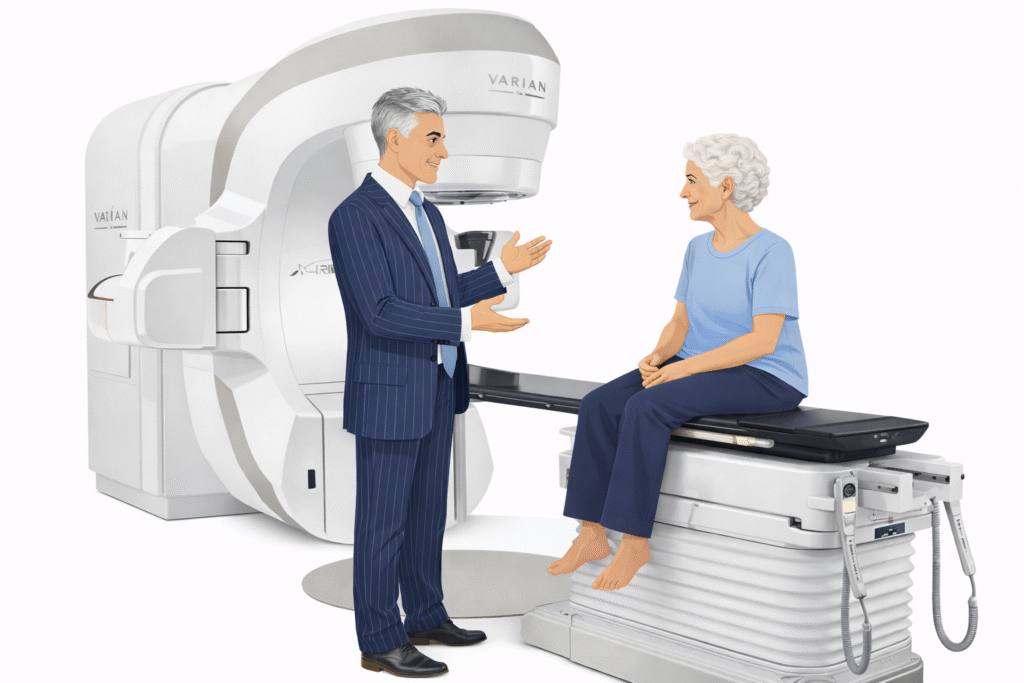
Is It Safe to Use Radiation for a Non-Cancer Condition?
For many patients considering low-dose radiotherapy, or LDRT, for osteoarthritis, the first question is not whether the treatment might help.
It is whether it is safe.
That is an entirely reasonable question.
Radiation can cause cancer. This is well established, particularly following higher radiation exposures and when treatment occurs at a younger age.
So when radiotherapy is being considered for a benign condition such as osteoarthritis, the potential benefit needs to justify exposing otherwise healthy tissues to ionising radiation.
The reassuring part is that LDRT for musculoskeletal conditions uses very small radiation doses, generally directed to a limited part of the body.
At Pinpoint Radiotherapy, a typical course for osteoarthritis is:
0.5 Gy per treatment for six treatments
giving a total dose of:
3 Gy
For comparison, courses of radiotherapy used to treat cancer commonly involve total doses many times higher.
However, dose alone does not determine radiation risk.
Age, the part of the body being treated, the amount of normal tissue exposed and the distribution of active bone marrow are also important.
That is why the safety of treating a knee or heel cannot simply be assumed to be identical to treating an area closer to the chest, abdomen or pelvis.
What Side Effects Occur During LDRT?
Immediate side effects from LDRT are generally limited.
Many patients notice no radiation-related symptoms during treatment.
Depending on the area treated, possible short-term effects can include:
mild skin redness
temporary skin dryness
a short-lived fluctuation in pain
mild local discomfort.
Significant acute radiation reactions are unusual at the doses used for osteoarthritis.
There is generally no nausea, hair loss or fatigue of the type sometimes associated with larger-volume cancer radiotherapy.
Patients do not become radioactive.
LDRT is delivered using external beam radiation. Once the treatment machine is switched off, there is no radiation left inside the body.
Patients can return home and be around family members, children and pets normally.
The More Important Question Is Long-Term Risk
For a benign condition, the main radiation safety discussion is not usually about what happens during the six treatment sessions.
It is about what could happen many years later.
Ionising radiation has the potential to damage DNA, and radiation exposure can theoretically increase the lifetime risk of developing a malignancy.
Unlike many immediate side effects, this is a stochastic risk.
This means we cannot identify an individual patient and say that their risk is exactly zero.
Instead, we need to consider how much radiation is being delivered, which tissues are exposed and how much time the patient has for a radiation-related cancer to potentially develop.
This is one reason age matters when LDRT is considered for a benign condition.
Why Does Age Matter?
Radiation-associated cancers generally take many years to develop.
A radiation exposure received at a young age therefore carries a different lifetime risk from the same exposure occurring much later in life.
Younger tissues may also be more radiosensitive.
For these reasons, LDRT has historically been used predominantly in older adults with persistent symptomatic musculoskeletal conditions.
Age is not the only consideration, but it is an important part of assessing whether the potential symptomatic benefit is proportionate to the long-term radiation risk.
This is also why LDRT should not be thought of as a casual treatment for every painful joint.
Patient selection matters.
Why Does the Joint Being Treated Matter?
The anatomy inside a radiation field can be just as important as the total dose.
Consider two very different examples.
A treatment directed to the knee, hand, ankle or heel mainly exposes tissues in a peripheral part of the body.
A treatment directed towards the shoulder, hip, pelvis or central trunk is closer to larger volumes of active bone marrow and, depending on the site, other radiosensitive organs.
The same nominal radiation dose can therefore have different implications depending on where it is delivered.
Modern treatment planning helps reduce unnecessary radiation exposure, but it cannot make radiation exposure completely disappear.
This distinction between peripheral and more central treatment sites has become particularly important following a large long-term safety study published in 2026.
What Did the New Long-Term Safety Study Examine?
In August 2026, researchers published one of the largest studies specifically examining the risk of malignancy following LDRT for benign musculoskeletal conditions.
The study looked back at 4,699 patients who had received LDRT between 1994 and 2011.
Collectively, these patients underwent:
5,614 courses of LDRT.
The mean age at treatment was 64 years.
This is important because these were not patients followed for only a few months after treatment.
The investigators were specifically interested in longer-term outcomes, including newly diagnosed cancers and causes of death.
The estimated post-treatment life expectancy in the cohort was approximately 21 years, providing a meaningful period during which potential late effects could be observed.
What Did the Study Find About Solid Cancers?
The researchers examined whether solid malignancies developed within previously irradiated regions.
Across the 4,699 patients, they identified:
three solid malignancies occurring within previously irradiated areas.
This represented an observed incidence of:
0.064%.
This is a reassuringly low number.
However, it is important to interpret it correctly.
The study was retrospective and did not include a matched untreated population.
It therefore cannot tell us that radiation caused those three cancers.
Equally, it cannot prove that the radiation contributed to none of them.
What it can tell us is that, across a very large group of patients followed after LDRT, solid cancers arising directly within the treated regions were uncommon.
What About Leukaemia and Other Blood Cancers?
The researchers also looked at haematological malignancies.
This analysis is particularly interesting because different parts of the skeleton contain different amounts of active red bone marrow.
The researchers therefore divided treatment areas according to whether radiation was delivered close to active marrow.
At 12.5 years, haematological malignancy-free survival was:
99.0% in patients treated away from active marrow
compared with:
97.7% in patients treated near marrow-rich areas.
That is an absolute difference of approximately 1.3 percentage points.
The difference was statistically significant, particularly when peripheral treatment regions were compared with areas such as the shoulder and trunk or pelvis.
This finding deserves careful interpretation.
It does not mean that LDRT caused blood cancer in 1.3% of patients.
This was an observational study rather than a randomised comparison with an untreated control population.
Patients receiving treatment to different anatomical regions may differ in age, underlying health and other characteristics.
Nevertheless, the finding supports something that makes biological sense.
When treating a benign condition, it is sensible to minimise unnecessary irradiation of active bone marrow.
Peripheral Joints Appear Particularly Reassuring
Most treatments in the study involved peripheral musculoskeletal sites.
Approximately:
62% were distal joints
and
37% were proximal joints.
Based on their findings, the authors concluded that contemporary LDRT appeared safe for peripheral indications, while treatments involving marrow-rich or central trunk structures should be used more cautiously.
This distinction is particularly relevant to treatments such as:
knee osteoarthritis
hand and finger osteoarthritis
thumb-base osteoarthritis
ankle and foot conditions
plantar fasciitis.
These sites allow treatment to be concentrated in relatively peripheral parts of the body.
This does not make the radiation risk zero.
It does, however, help explain why the safety profile for peripheral LDRT appears reassuring.
What About Treatment Around the Shoulder or Hip?
More proximal joints require greater consideration.
The shoulder lies closer to active marrow and the chest.
The hip lies close to the pelvis, where a substantial proportion of adult red bone marrow is located, as well as other radiosensitive organs.
This does not automatically mean these areas should never be treated.
It means the benefit and risk assessment needs to be more careful.
The 2026 safety study specifically concluded that treatment near marrow-rich or central structures should be applied judiciously.
At Pinpoint Radiotherapy, we therefore do not consider all joints biologically equivalent simply because the same radiation dose may be prescribed.
What Did We Know Before the 2026 Study?
The question of secondary cancer risk has been discussed in the LDRT literature for many years.
Much of the previous evidence came from mathematical risk modelling, historical radiation cohorts and smaller long-term observational studies.
Estimating risk is difficult.
Many radiation-risk models were derived from circumstances quite different from contemporary LDRT, including whole-body exposure, older radiation techniques or substantially different dose distributions.
One historical study followed women who had received approximately 6 Gy of radiotherapy to the shoulder. After an average follow-up exceeding 20 years, breast cancer incidence was not higher than expected in the general population.
Reviews nevertheless continued to emphasise that radiation-induced malignancy could not simply be dismissed, particularly in younger patients and when treating areas close to radiosensitive tissues.
The 2026 study is important because it adds direct long-term clinical data from almost 4,700 patients actually treated for benign musculoskeletal disorders.
What Do Current Guidelines Say About Safety?
In 2026, the American Radium Society published the first multidisciplinary US Appropriate Use Criteria specifically addressing LDRT for osteoarthritis.
The panel included radiation oncologists, rheumatologists, orthopaedic specialists and a patient advocate.
Safety was one of the specific questions addressed by the evidence review.
The resulting guidance emphasises that treatment appropriateness depends on more than simply having osteoarthritis.
Factors including:
age
severity and duration of symptoms
previous conservative treatment
the joint being treated
radiation exposure
overall clinical circumstances
all contribute to determining whether LDRT is reasonable for an individual patient.
The guideline reflects the broader principle that LDRT should be used selectively rather than as a first response to uncomplicated osteoarthritis.
Is 3 Gy Really a Low Radiation Dose?
In radiotherapy terms, yes.
A typical LDRT course for osteoarthritis involves a total dose of:
3 Gy
delivered as:
six treatments of 0.5 Gy.
Cancer radiotherapy often involves total doses in the range of several tens of Gray.
But it would be misleading to say that 3 Gy is harmless simply because it is lower than a cancer treatment dose.
Radiation risk does not depend solely on comparing total dose numbers.
The volume treated, dose per treatment, tissues exposed and patient’s age all matter.
This is why even low-dose treatments should be planned carefully.
Why Do We Still Use CT Planning?
It might seem unnecessary to perform detailed radiotherapy planning when the radiation dose is so low.
In fact, careful planning is part of reducing risk.
A planning CT allows the treatment team to:
identify the joint accurately
define the intended treatment volume
understand the surrounding anatomy
choose appropriate radiation beam arrangements
limit unnecessary exposure to nearby tissues.
The principle is not simply to use a low dose.
It is to use a low dose accurately.
Can LDRT Damage the Joint?
The dose used for osteoarthritis is not intended to damage cartilage, bone or other joint structures.
At low doses, the biological effects being investigated are predominantly anti-inflammatory and immunomodulatory rather than destructive.
Modern trials have generally reported few significant acute treatment-related adverse events at the doses used for osteoarthritis.
For example, contemporary studies using a total dose of 3 Gy have reported very low rates of treatment-related toxicity.
Research is continuing to examine not just symptoms but also structural changes within treated joints over longer periods.
Does LDRT Affect Future Treatments?
Receiving LDRT does not usually prevent patients from continuing other osteoarthritis treatments.
Exercise, physiotherapy and medication can generally continue as appropriate.
Injections can still be considered.
Future procedures can also remain possible if they are required.
Any future treating clinician should nevertheless be informed that radiotherapy has previously been delivered to the area.
The relatively small radiation doses used for LDRT are very different from the doses associated with cancer radiotherapy, where tissue healing and subsequent procedures may require much greater consideration.
What About Having a Second Course?
A second LDRT course is sometimes considered when there has been a meaningful but incomplete response to the first treatment.
The decision is not automatic.
Because radiation exposure is cumulative, previous treatment needs to be included when considering further radiotherapy.
The potential additional benefit needs to justify the additional dose.
This is another reason why treatment records and accurate planning are important.
Why Patient Selection Is Central to Safety
The safest treatment is not simply the one with the lowest radiation dose.
It is the treatment used in the right patient, for the right indication, at the right site.
When considering LDRT, we look at:
whether osteoarthritis is actually responsible for the symptoms
whether appropriate conservative treatments have already been tried
how much the symptoms affect function and quality of life
the patient’s age
the location being treated
nearby radiosensitive tissues
previous radiation exposure
whether the likely benefit justifies the radiation exposure.
For a younger person with mild intermittent symptoms, the balance may be very different from that of an older adult with persistent pain and substantial functional limitation despite conservative treatment.
So How Safe Is LDRT?
The available evidence is reassuring, particularly for peripheral musculoskeletal treatments.
The largest recent long-term study followed almost 4,700 patients and found only three solid malignancies within previously irradiated regions, an observed incidence of 0.064%.
It also found that patients treated away from active bone marrow had very high haematological malignancy-free survival at long-term follow-up.
At the same time, the study identified a signal supporting greater caution when radiation is delivered close to marrow-rich or central anatomical regions.
That leads to a more useful conclusion than simply saying LDRT is either “safe” or “unsafe”.
For appropriately selected older patients receiving carefully planned treatment to a peripheral joint, the available long-term evidence suggests that the radiation-related risk is low.
It is not zero.
That distinction matters when radiotherapy is being used for a benign condition.
LDRT Safety at Pinpoint Radiotherapy
At Pinpoint Radiotherapy, safety begins before treatment is planned.
Patients are assessed by a radiation oncologist and the expected benefit of LDRT is considered alongside the potential radiation risk.
Where treatment is appropriate, modern CT-based planning is used to accurately define the treatment area and minimise unnecessary exposure to surrounding tissues.
A typical osteoarthritis course consists of:
0.5 Gy per treatment for six treatments
for a total dose of:
3 Gy.
Particular attention is given to age, anatomical location, previous radiation exposure and the amount of normal tissue within the treatment field.
The new long-term data involving thousands of patients are reassuring, especially for peripheral joints.
However, our approach remains the same.
LDRT should be used selectively, the radiation exposure should be kept as limited as reasonably practical, and patients should have an informed discussion about both potential benefit and long-term risk before deciding whether treatment is right for them.
Evidence and further reading
Blach RM, Sonnhoff M, Muecke R, et al. Risk of radiation-induced malignancy after low-dose radiotherapy for non-malignant musculoskeletal disorders. Int J Radiat Oncol Biol Phys. 2026. PubMed
Dove A, Koneru B, Small W Jr, et al. American Radium Society Appropriate Use Criteria for Low-Dose Radiotherapy for Treatment of Osteoarthritis. Am J Clin Oncol. 2026. PubMed
Ott OJ, Niewald M, Weitmann HD, et al. DEGRO guidelines for the radiotherapy of non-malignant disorders. Part II: Painful degenerative skeletal disorders. Strahlenther Onkol. 2015. PubMed