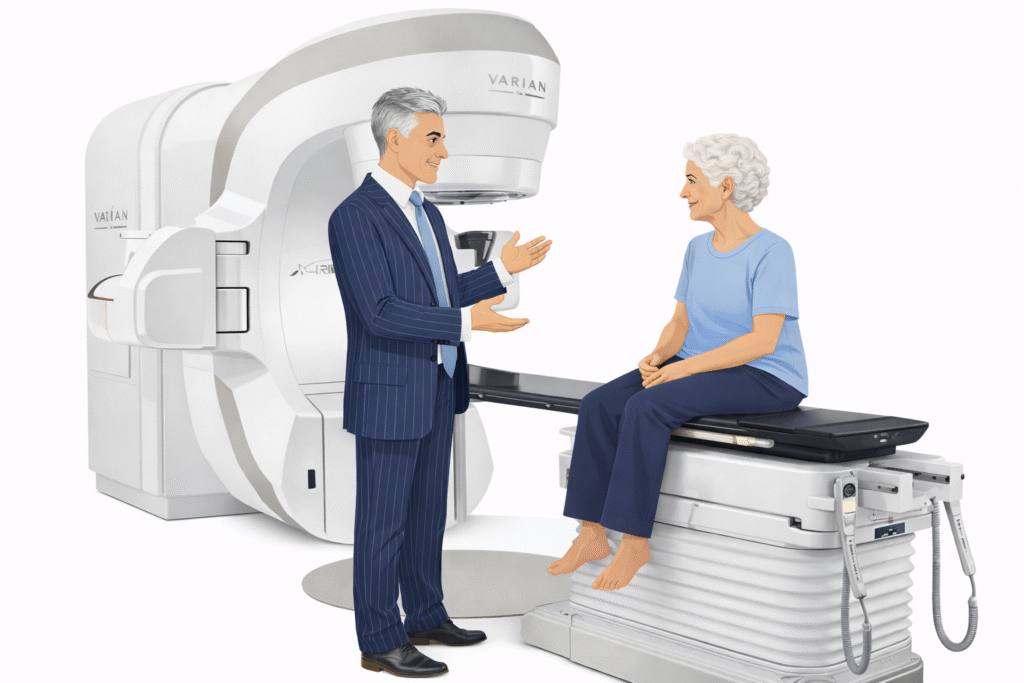
A Different Way of Delivering Radiotherapy
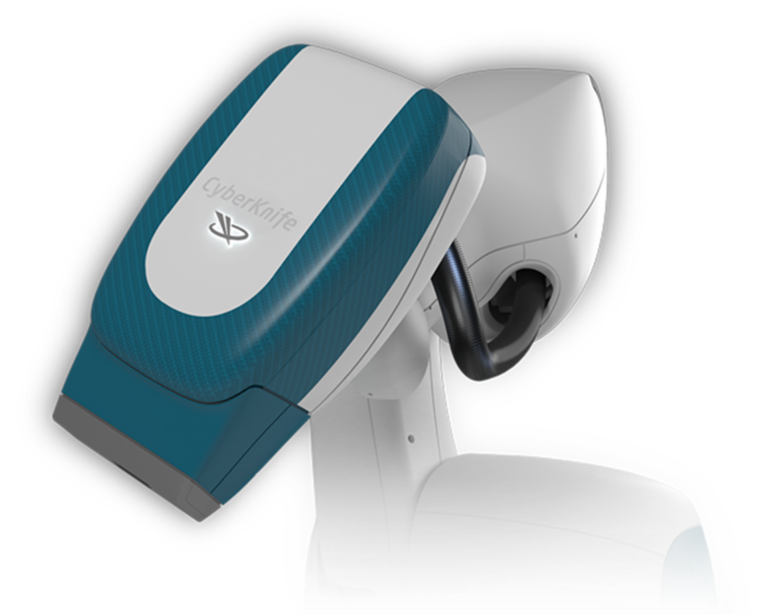
CyberKnife is an advanced robotic radiotherapy system designed to deliver highly focused stereotactic radiation with exceptional precision.
Despite the name, there is no knife and no surgery involved.
What makes CyberKnife different is the way the radiation is delivered.
Instead of a conventional radiotherapy machine rotating around the patient on a fixed gantry, CyberKnife uses a compact linear accelerator mounted on a six-axis robotic arm.
The robot can direct radiation towards a tumour from a large number of different angles around the patient, while integrated imaging allows the system to monitor the position of the target during treatment.
The newer CyberKnife S7 system combines robotic delivery, non-coplanar radiation beams and real-time target tracking with sub-millimetre stereotactic precision.
For selected cancers, particularly prostate cancer, this combination can be especially useful.
CyberKnife S7 Comes to Melbourne
Victoria’s first CyberKnife centre opened at 5D Clinics Melbourne in Cremorne in July 2025, through a collaboration between 5D Clinics and Icon Cancer Centre.
The centre is also the first CyberKnife service on Australia’s east coast.
Among the first patients treated was the first patient with prostate cancer to receive CyberKnife treatment in Melbourne, under the care of Radiation Oncologist Dr Paul Conway.
The arrival of CyberKnife in Melbourne means patients can now access this form of robotic stereotactic radiotherapy locally without travelling interstate.
Why Is CyberKnife Different?
There are several features that distinguish CyberKnife from more conventional radiotherapy systems.
A robotic treatment arm
The radiation source is mounted on a computer-controlled robotic arm with six degrees of freedom.
This allows radiation to be delivered from a very large number of positions around the patient.
The robot does not touch the patient. It moves through a sequence of carefully calculated positions while delivering the treatment.
Non-coplanar beam delivery
Many conventional radiotherapy treatments are delivered predominantly around a single plane.
CyberKnife can deliver radiation from numerous non-coplanar directions.
These different beam paths converge on the target while spreading the entry and exit radiation through surrounding tissues.
This flexibility can help produce highly conformal treatment plans and steep radiation dose gradients around selected targets.
Steep dose gradients
Stereotactic radiotherapy requires a high degree of control over where the radiation dose goes.
Within the intended target, the prescribed radiation dose needs to be delivered accurately.
Immediately outside the target, we want that dose to fall away as quickly as possible.
CyberKnife’s combination of robotic positioning and large numbers of possible beam directions can produce steep dose gradients, helping limit unnecessary radiation exposure to nearby normal structures.
Real-time target tracking
Perhaps the most distinctive feature of CyberKnife is its ability to monitor selected tumours during treatment.
The body does not remain completely still.
The prostate can move because of changes in the rectum, bowel and bladder. Lung and liver tumours can move as a patient breathes.
CyberKnife uses integrated X-ray imaging to repeatedly identify the position of the target.
If the target moves, the robotic system can adjust treatment delivery to account for that movement.
This is known as intrafraction tracking.
Rather than simply positioning a patient accurately at the beginning of treatment and assuming the target remains there, CyberKnife can continue to monitor its position while treatment is being delivered.
Why Is This Particularly Useful for Prostate Cancer?
The prostate sits in a complex anatomical location.
The rectum lies directly behind it.
The bladder sits above it.
The urethra passes through the prostate itself.
The prostate can also move during a treatment session.
For CyberKnife prostate treatment, small fiducial markers are placed within the prostate before radiotherapy.
During treatment, the system repeatedly identifies these markers using X-ray imaging.
This allows the CyberKnife system to monitor the position of the prostate throughout treatment and make corrections if its position changes.
For stereotactic treatment, where a relatively high radiation dose is delivered during each session, this ability to monitor the target during treatment is particularly valuable.
Prostate Cancer Treatment in Five Sessions
For appropriately selected men with localised prostate cancer, stereotactic ablative body radiotherapy, or SABR, can allow the complete radiation treatment course to be delivered in just five sessions.
The international PACE-B phase III trial has provided strong evidence supporting this approach.
At five years, 95.8% of men treated with SABR were free from biochemical or clinical failure, compared with 94.6% of men receiving longer conventional or moderately hypofractionated radiotherapy schedules.
Five-treatment SABR was shown to be non-inferior to the longer radiation schedules in the population studied.
A substantial proportion of men receiving SABR in PACE-B were treated using CyberKnife.
PACE-B was not designed to prove that CyberKnife is superior to other modern radiotherapy systems. It does, however, provide important evidence that CyberKnife is an established platform for delivering prostate SABR within a major international clinical trial.
A Non-Surgical Option for Localised Prostate Cancer
Men with localised prostate cancer may have several appropriate management options depending on their cancer, age, general health and personal priorities.
For selected men requiring treatment, CyberKnife SABR offers a non-surgical treatment option.
This can be particularly relevant for men who are not suitable for surgery or who, after considering the available options, prefer to avoid an operation.
There is no incision and the prostate is not removed.
Treatment is generally delivered as an outpatient.
The decision between surgery, radiation therapy and other management approaches remains individual and should be made after discussing the expected benefits and potential side effects of each option.
CyberKnife Can Treat More Than Prostate Cancer
CyberKnife was designed for stereotactic treatment throughout the body.
Depending on the individual situation, it can be used for selected tumours involving areas such as:
brain
spine
lung
liver
kidney
prostate
lymph nodes
bone
other oligometastatic sites.
Different cancers make use of different CyberKnife capabilities.
For prostate cancer, real-time prostate tracking is particularly valuable.
For selected lung and liver tumours, the system can use Synchrony respiratory tracking to account for tumour movement during breathing.
For brain and spinal tumours, the ability to deliver highly focused non-coplanar beams can be useful when treating targets close to critical neurological structures.
Is CyberKnife Better Than a Conventional Linear Accelerator?
Modern conventional linear accelerators can also deliver excellent stereotactic radiotherapy.
CyberKnife is not automatically the best treatment platform for every cancer or every patient.
What makes it different is the combination of:
six-axis robotic radiation delivery
large numbers of non-coplanar beam directions
highly conformal stereotactic treatment
steep dose gradients
integrated imaging during treatment
real-time target tracking
automatic correction for target movement
sub-millimetre stereotactic precision.
For selected tumours, these capabilities can provide a particularly elegant solution to the challenge of delivering highly focused radiation to a target that may be small, difficult to access or moving during treatment.
CyberKnife at Pinpoint Radiotherapy
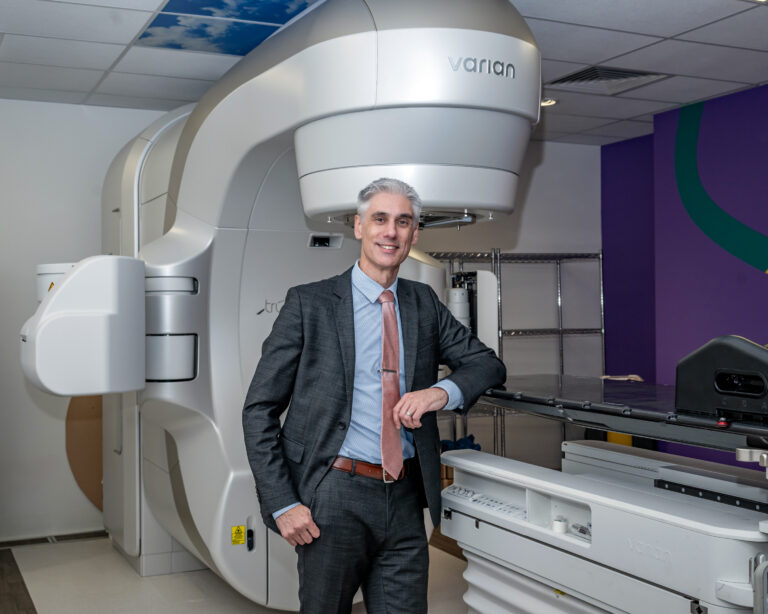
Dr Paul Conway provides CyberKnife treatment through 5D Clinics Melbourne in Cremorne as part of his radiation oncology practice.
He has dedicated training and credentialing in CyberKnife treatment, with particular clinical interests in prostate cancer, stereotactic radiotherapy and oligometastatic disease.
For localised prostate cancer, the first question remains whether SABR is an appropriate treatment for the individual patient.
When it is, CyberKnife provides a sophisticated way of delivering that treatment.
A robotic arm directs radiation from multiple non-coplanar positions.
Integrated imaging monitors the prostate during treatment.
The system can respond when the target moves.
And the radiation can be shaped with very high precision around the intended treatment volume.
The technology is impressive, but its purpose is straightforward.
Deliver the intended radiation dose accurately to the cancer while limiting unnecessary radiation to the surrounding normal tissues.
For selected patients with localised prostate cancer, CyberKnife SABR now provides an evidence-based, non-surgical treatment option available here in Melbourne.
Evidence and further reading
van As NJ, Griffin C, Tree AC, et al. Phase 3 Trial of Stereotactic Body Radiotherapy in Localized Prostate Cancer. N Engl J Med. 2024. PubMed
Tree AC, Ostler P, van der Voet H, et al. PACE-B 2-year toxicity results from a randomised phase 3 trial. Lancet Oncol. 2022. PubMed
Oehler C, Roehner N, Sumila M, et al. Intrafraction Prostate Motion Management for Ultra-Hypofractionated Radiotherapy of Prostate Cancer. Curr Oncol. 2022. PubMed
Accuray. CyberKnife S7 System technical information including robotic delivery, non-coplanar beam angles, sub-millimetre accuracy and real-time motion tracking. CyberKnife S7 System
5D Clinics. Victoria’s first CyberKnife centre opens at 5D Clinics Melbourne. 22 July 2025. 5D Clinics Melbourne opening
Accuray. First SBRT treatments using the CyberKnife System in Melbourne. 2025. Accuray Melbourne milestone announcement