Five-Treatment Radiotherapy for Localised Prostate Cancer
For selected men with localised prostate cancer, stereotactic ablative body radiotherapy, or SABR, allows an entire course of radiation treatment to be delivered in just five sessions.
This approach is supported by the international PACE-B phase III trial, which included 874 men with low- and intermediate-risk prostate cancer. At five years, 95.8% of men treated with five-fraction SABR were free from biochemical or clinical failure compared with 94.6% receiving longer conventional or moderately hypofractionated radiotherapy schedules. SABR was therefore shown to be non-inferior to the longer treatment approaches.
The significance for patients is straightforward. A treatment course that previously required several weeks can, for appropriately selected men, now be delivered over five visits while maintaining excellent cancer control.
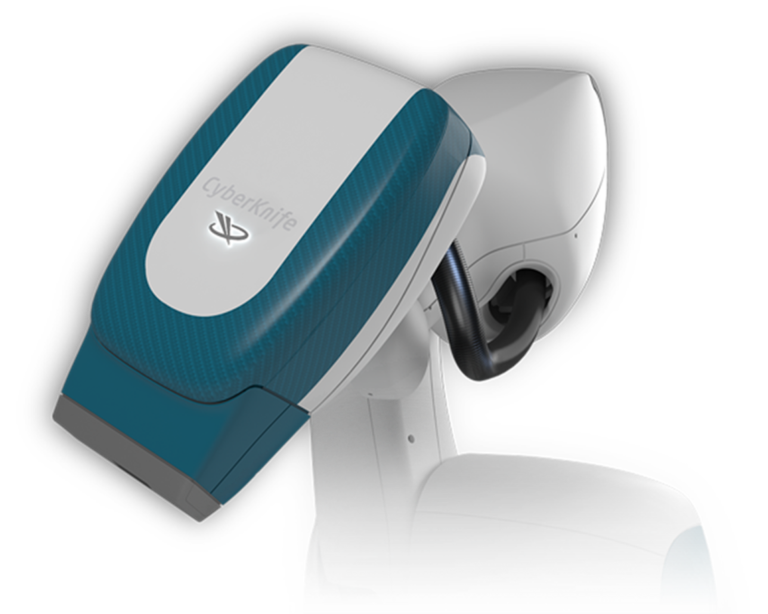
How CyberKnife Delivers Prostate SABR
CyberKnife is one way of delivering prostate SABR. It uses a compact linear accelerator mounted on a six-axis robotic arm, allowing radiation to be delivered from many non-coplanar directions around the patient and shaped closely around the prostate.
An important feature for prostate treatment is real-time intrafraction tracking. Small fiducial markers are placed within the prostate before treatment, and repeated X-ray imaging identifies their position while radiation is being delivered. If the prostate moves because of changes in bladder or rectal filling, the CyberKnife system can detect that movement and adjust where the radiation beam is directed.
This is particularly relevant when delivering SABR because a relatively high radiation dose is given during each of the five treatments. The aim is to maintain accurate coverage of the prostate while limiting unnecessary radiation to nearby structures such as the bladder and rectum.
Modern conventional linear accelerators can also deliver excellent prostate SABR using sophisticated image guidance and motion-management techniques. CyberKnife is distinctive because robotic delivery and real-time target tracking are built into the treatment platform.
What Did PACE-B Show About CyberKnife?
PACE-B also provided an opportunity to examine outcomes according to the technology used to deliver SABR.
Among 414 men included in the treatment-platform analysis, 169 received CyberKnife treatment and 245 received SABR using a conventional linear accelerator.
At two years, grade 2 or greater urinary toxicity was reported in approximately 6% of men treated with CyberKnife compared with 17% of those treated using conventional linac SABR. Significant bowel toxicity was low with both approaches.
This is an interesting clinical finding, but it needs to be interpreted carefully. Patients were not randomly assigned to CyberKnife or conventional linac treatment. They were treated using the technology available at their centre, meaning differences between centres, patients and treatment techniques may also have contributed to the result.
The study therefore does not prove that CyberKnife itself caused the lower urinary toxicity. It does, however, provide an important clinical observation alongside the technical rationale for monitoring and correcting prostate movement throughout treatment.
Our Approach to Prostate SABR
At Pinpoint Radiotherapy, the first question is not which machine should be used, but whether five-treatment SABR is an appropriate treatment for the individual patient.
Factors including the stage and grade of the cancer, PSA, prostate size, urinary symptoms, imaging findings and other health considerations all contribute to treatment selection. For suitable men, SABR provides a non-surgical treatment option delivered over five outpatient sessions.
Where CyberKnife is appropriate, its combination of robotic non-coplanar beam delivery and real-time prostate tracking provides a highly sophisticated way of delivering that treatment.
The evidence from PACE-B supports five-treatment SABR as an effective option for selected men with localised prostate cancer, while the lower urinary toxicity observed in the CyberKnife cohort provides an additional reason to remain interested in how the treatment is delivered, not simply how many fractions are given.
Evidence and further reading
van As NJ, Tree AC, Patel J, et al. Phase 3 Trial of Stereotactic Body Radiotherapy in Localized Prostate Cancer. N Engl J Med. 2024. PubMed PubMed Central (PMC)
Tree AC, Ostler P, van der Voet H, et al. Intensity-modulated radiotherapy versus stereotactic body radiotherapy for prostate cancer (PACE-B): 2-year toxicity results from a randomised phase 3 trial. Lancet Oncol. 2022. PubMed PubMed
Cooper S, Patel J, Moore C, et al. Patient-reported Outcomes After Prostate Stereotactic Body Radiotherapy at 5 yr: Results from the PACE-B Trial. Eur Urol. 2026. PubMed PubMed
Ratnakumaran R, Sasitharan A, Khan A, et al. Dosimetric Comparison of CyberKnife and Conventional Linac Prostate Stereotactic Body Radiation Therapy Plans: Analysis of the PACE-B Study. Int J Radiat Oncol Biol Phys. 2026. PubMed