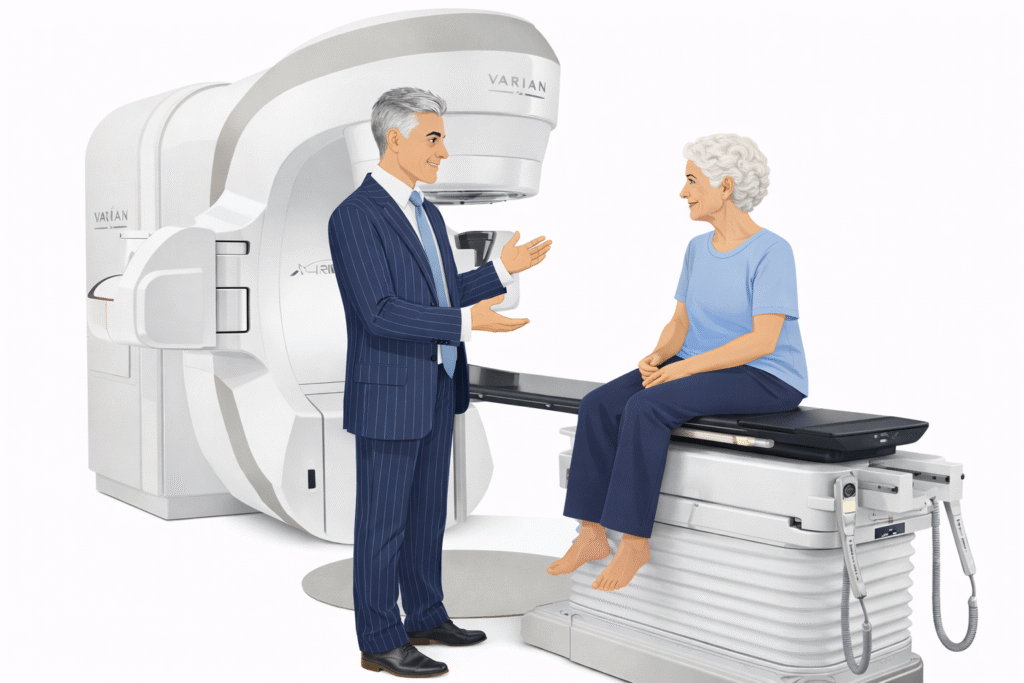
What Is Stereotactic Radiotherapy?
Stereotactic ablative body radiotherapy, or SABR, is an advanced form of radiation therapy that delivers a highly focused dose of radiation to a precisely defined tumour or area of cancer.
Modern imaging is used to identify the target accurately and treatment is delivered from multiple directions, allowing the radiation dose to conform closely to the tumour while falling away rapidly in the surrounding normal tissues. This precision makes it possible to safely deliver a larger dose during each treatment than would usually be given with conventional radiotherapy.
As a result, SABR is typically completed in only a small number of treatment sessions, often between one and five treatments depending on the cancer, its location and the surrounding anatomy. Treatment is non-invasive, with no incision or anaesthetic required.
SABR is not suitable for every tumour. Its greatest value is in situations where the cancer can be clearly identified, accurately targeted and treated while keeping the dose to nearby sensitive structures within safe limits.
Where Is SABR Used?
SABR is now used across a growing range of cancers.
For localised cancer, it can be an established treatment option in selected patients with cancers such as prostate, lung and kidney cancer. It is also used for selected tumours involving the liver and other sites where a highly focused treatment is appropriate.
SABR has also become increasingly important when cancer has spread beyond its original location.
Oligometastatic disease describes a situation where cancer has spread to only a limited number of sites. In selected patients, SABR can be used to target these individual areas of disease. Randomised trials such as SABR-COMET have helped establish the principle that treating visible metastases can provide meaningful disease control in appropriately selected patients.
A related situation is oligoprogressive disease. Here, most of a patient’s cancer remains controlled by systemic treatment such as hormone therapy, targeted therapy, chemotherapy or immunotherapy, but one or a small number of sites begin to grow. Treating those resistant areas with SABR can sometimes allow an otherwise effective systemic treatment to continue for longer before a change in therapy is required.
The role of SABR therefore varies considerably between patients. In some situations it is being used to treat a localised cancer, while in metastatic disease the goal may be to achieve durable control of individual lesions or delay the need for the next line of systemic treatment.
Why Precision Matters
The defining feature of SABR is not simply that it uses fewer treatments. It is the precision required to safely deliver a high dose during each treatment session.
Detailed CT, MRI and PET imaging may be incorporated into planning so that the tumour and nearby organs can be accurately defined. Modern treatment machines use image guidance immediately before, and in some cases during, treatment to ensure that the radiation remains directed towards the intended target.
Different parts of the body create different challenges. A prostate can move as the bladder and rectum change position. Lung and liver tumours may move as a patient breathes. Tumours in the brain or spine may lie only millimetres from important neurological structures. Technologies including stereotactic image guidance, implanted fiducial markers, respiratory motion management and real-time tracking can therefore be used depending on the tumour being treated.
Because the dose falls away rapidly outside the target, SABR can limit unnecessary radiation to surrounding tissues. Side effects depend on the location, size and dose of treatment and the nearby organs, and SABR is not automatically less toxic simply because it involves fewer visits. Careful planning and patient selection remain essential.
Stereotactic Radiotherapy at Pinpoint Radiotherapy
At Pinpoint Radiotherapy, the starting point is determining whether SABR is appropriate for the individual cancer rather than simply whether the technology is available.
Assessment considers the type and location of the cancer, its size and number of sites, previous treatments, imaging findings, nearby normal tissues and the broader treatment strategy. For metastatic disease, this also means considering what systemic treatments have already been given and what the purpose of treating individual sites would be.
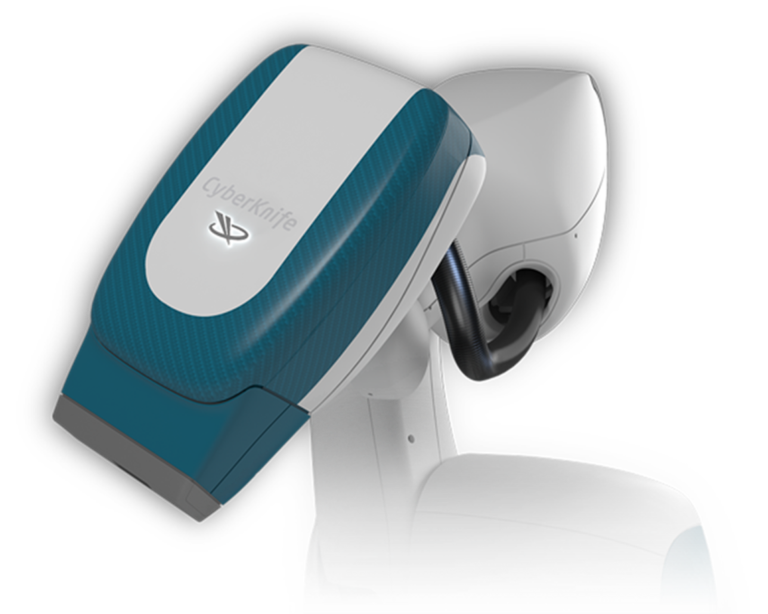
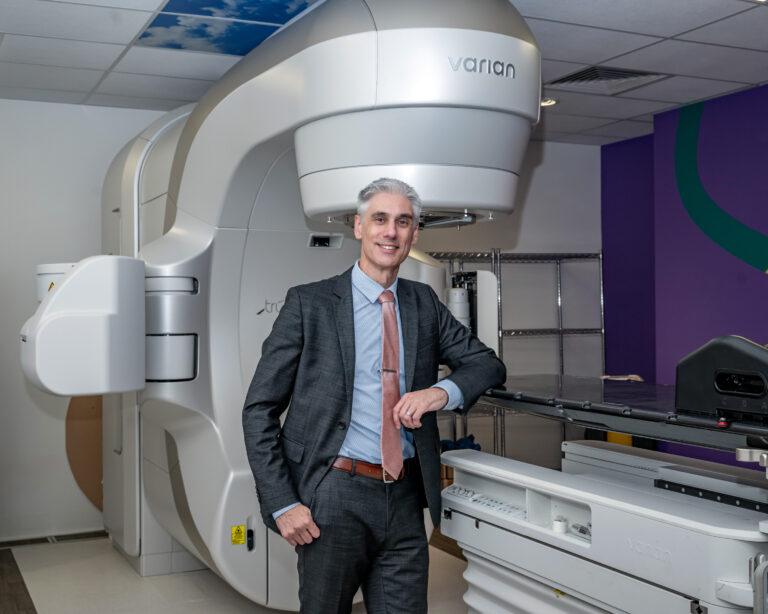
Dr Paul Conway has a particular clinical interest in stereotactic radiotherapy for prostate cancer, oligometastatic disease and tumours involving sites including the lung, kidney, liver, brain and spine. Treatment can be delivered using modern stereotactic platforms including conventional linear accelerators and, where appropriate, the CyberKnife S7 robotic radiotherapy system.
For suitable patients, SABR provides a way of delivering highly focused radiation over a small number of treatments, with the treatment approach tailored to the tumour, its movement and the anatomy surrounding it.
The technology is sophisticated, but the principle is simple: deliver the intended radiation dose accurately to the cancer while limiting unnecessary treatment of the healthy tissues around it.
Evidence and further reading
Timmerman R, Herman J, Cho LC. Emergence of stereotactic body radiation therapy and its expanding role in cancer treatment. Adv Drug Deliv Rev. 2017. PubMed
Palma DA, Olson R, Harrow S, et al. Stereotactic ablative radiotherapy versus standard of care palliative treatment in patients with oligometastatic cancers (SABR-COMET). Lancet. 2019. PubMed
Palma DA, Olson R, Harrow S, et al. Stereotactic Ablative Radiotherapy for the Comprehensive Treatment of Oligometastatic Cancers: Long-Term Results of the SABR-COMET Phase II Randomized Trial. J Clin Oncol. 2020. PubMed
Lievens Y, Guckenberger M, Gomez D, et al. Defining oligometastatic disease from a radiation oncology perspective: an ESTRO-ASTRO consensus document. Radiother Oncol. 2020. PubMed