Why Spine Metastases Need Precise Treatment
The spine is a common site for metastatic cancer. Some spinal metastases cause pain, while others are discovered on imaging before significant symptoms develop. Treatment depends on the behaviour of the cancer, the extent of disease elsewhere, the stability of the affected vertebra and how close the tumour lies to the spinal cord or nearby nerves.
Radiotherapy has long been used to relieve pain from spinal metastases. Stereotactic ablative body radiotherapy, or SABR, allows a much higher and more focused radiation dose to be delivered to selected spinal tumours, with the aim of achieving more durable pain relief and local tumour control.
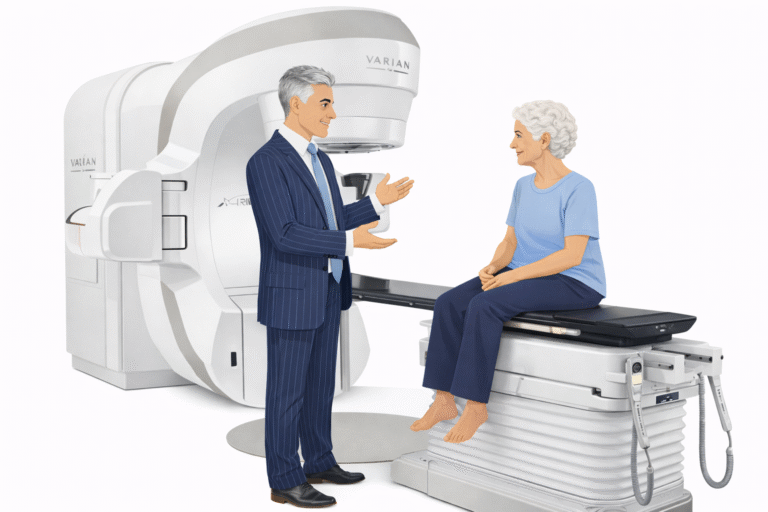
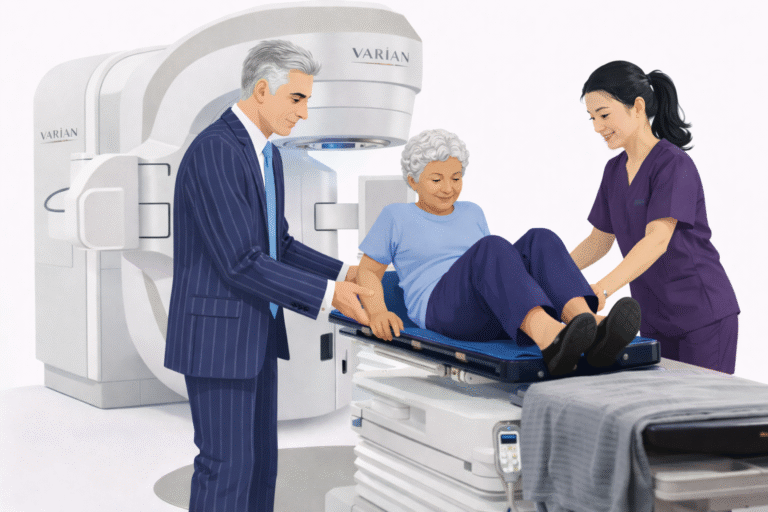
The challenge is that the tumour may sit immediately beside the spinal cord. High-resolution MRI is therefore combined with treatment-planning imaging to define both the cancer and the spinal cord accurately. Modern image guidance then allows treatment to be delivered with millimetre-level precision, creating a steep fall in radiation dose between the tumour and these sensitive neurological structures.
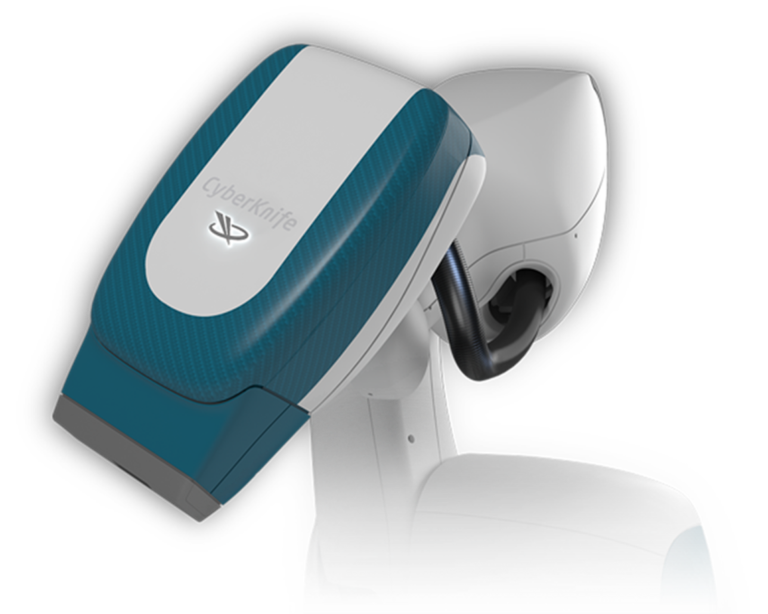
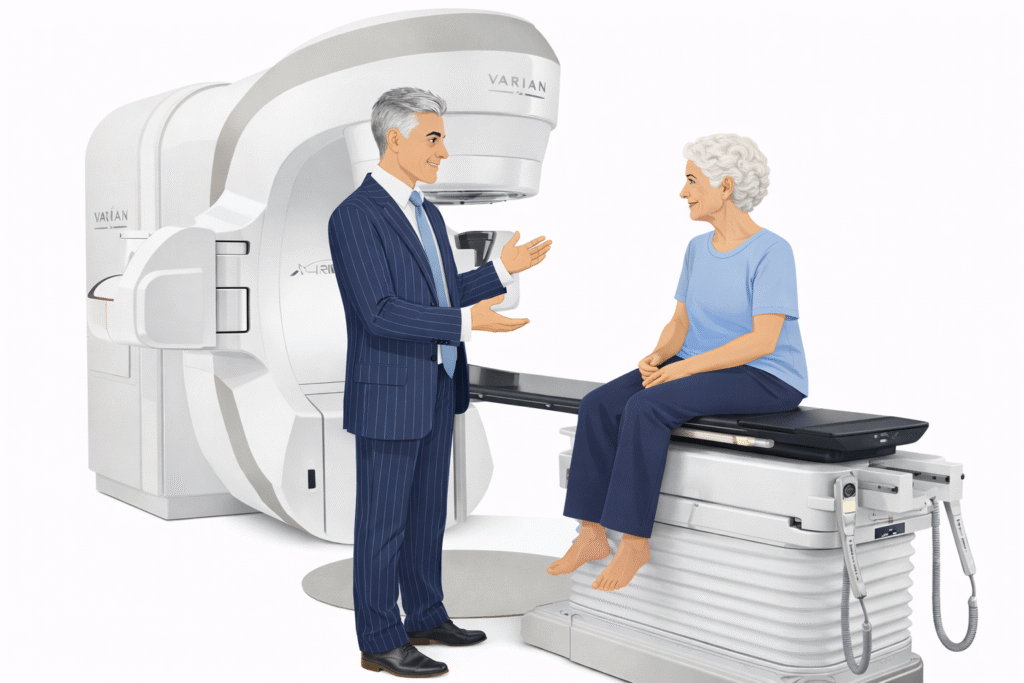
SABR can be delivered using modern linear accelerators or robotic platforms such as CyberKnife. CyberKnife can use the bony anatomy of the spine for image-guided tracking without requiring implanted markers, while its robotic arm allows radiation to be delivered from many non-coplanar directions. The technology used is less important than accurate imaging, careful planning and reliable positioning throughout treatment.
What Does the Evidence Show?
One of the most important trials was the international SC.24 study, which compared stereotactic treatment with conventional palliative radiotherapy in selected patients with painful spinal metastases. At three months, 35% of patients treated with spine SABR had complete relief of their treated pain compared with 14% following conventional radiotherapy. This showed that, in appropriately selected patients, a higher-dose stereotactic approach could produce a deeper pain response.
The broader evidence also demonstrates strong tumour control. A systematic review and meta-analysis used to inform the ESTRO spine SABR guideline included 5,736 patients and more than 7,200 treated spinal metastases. Across the studies, approximately 83% of patients experienced a pain response, while the pooled one-year local tumour control rate was 94%.
These outcomes have helped move spine SABR beyond simply short-term pain relief. For patients expected to live longer with metastatic cancer, maintaining control of an individual spinal metastasis can be important in preventing later progression at that site and reducing the likelihood that further treatment will be required.
SABR does, however, have specific risks. The most important is vertebral compression fracture, because a vertebra already weakened by cancer can occasionally fracture following high-dose treatment. In the large ESTRO analysis, this occurred in approximately 9% of treated lesions, although only a small proportion required surgical stabilisation. Serious radiation injury to the spinal cord was very uncommon when modern dose constraints and treatment techniques were used.
Who Is Suitable for Spine SABR?
Not every spinal metastasis should be treated stereotactically. Patient selection is particularly important.
SABR is often most attractive for patients with oligometastatic disease, a limited number of progressing sites or a spinal metastasis where durable local control is important. It may also sometimes be used when a previously irradiated spinal tumour recurs, although retreatment requires especially careful consideration of the radiation dose already received by the spinal cord.
Before treatment, the stability of the vertebra and the degree of tumour extension towards the spinal canal need to be assessed. A patient with an unstable spine or significant spinal cord compression may require surgical assessment rather than proceeding directly to SABR. Conversely, a stable lesion without significant neurological compression may be well suited to stereotactic treatment.
This is why spine SABR is best considered as part of the overall management of metastatic disease rather than simply as a higher-dose version of conventional radiotherapy.
Our Approach to Spinal Metastases
At Pinpoint Radiotherapy, spinal metastases are assessed according to the cancer type, symptoms, MRI and PET or CT findings, spinal stability, proximity to the spinal cord, previous radiotherapy and the extent of disease elsewhere in the body.
For suitable patients, SABR is typically delivered over only a small number of treatments. Detailed MRI-based planning and modern image guidance allow the dose to be shaped closely around the affected vertebra while respecting strict limits for the spinal cord and nearby nerves.
Where appropriate, treatment can be delivered using conventional stereotactic linear accelerator techniques or CyberKnife robotic radiotherapy with spine tracking. The choice of platform is tailored to the anatomy and treatment requirements rather than using one technology for every patient.
The aim is to achieve durable control of the spinal metastasis and meaningful relief of pain while protecting the spinal cord and maintaining spinal function for as long as possible.